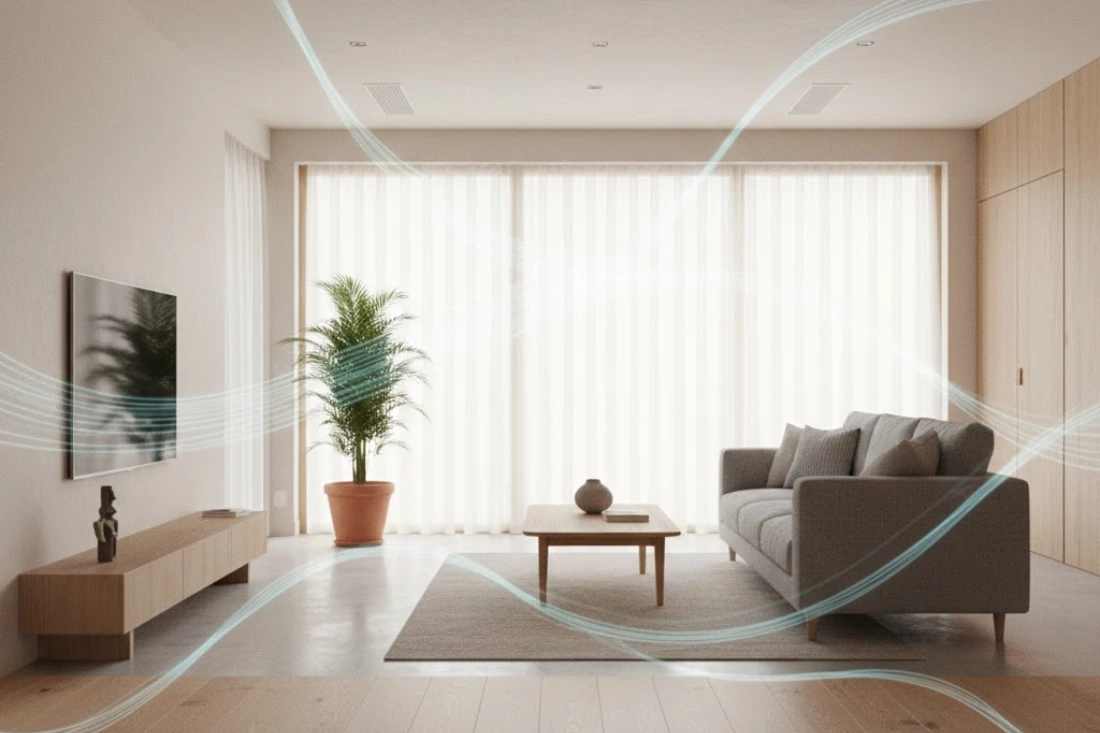
Forced ventilation and controlled ventilation designed to eliminate dampness, improve indoor air quality, and comply with CTE HS3 regulations.
SPECIALIST VMC INSTALLERS
Forced ventilation systems to eliminate dampness and improve indoor air in homes
Forced ventilation, or VMC, is currently one of the most effective solutions for eliminating dampness at home, improving indoor air quality, and preventing recurring issues such as condensation, mould, or persistent odours. In modern homes, which are increasingly airtight, relying solely on opening windows is no longer sufficient to guarantee a healthy environment.
A well-designed forced ventilation system allows for continuous and controlled air renewal, acting directly on the source of many dampness problems in homes and improving daily comfort.
What is forced ventilation and why is it necessary in homes?
Forced ventilation, also known as mechanical forced ventilation (VMC), is a system that renews indoor air using mechanical equipment that extracts stale air and introduces clean air continuously and in a controlled manner. Unlike natural ventilation, it does not depend on the weather or user habits.
In mechanical ventilation for homes, these systems have become essential due to the high level of airtightness in modern constructions. Without proper renewal, steam, CO₂, and pollutants accumulate, causing persistent dampness at home and poor indoor air quality.
Natural ventilation vs. CONTROLLED ventilation: key differences
Natural ventilation relies on opening windows or uncontrolled infiltration. It is irregular, weather-dependent, and rarely guarantees constant air renewal.
Forced ventilation, or controlled ventilation, on the other hand, ensures continuous and balanced flow rates throughout the day. This allows for maintaining appropriate levels of humidity and air quality, which is fundamental when looking for a definitive way to eliminate dampness at home.
Mechanical forced ventilation
How to solve dampness at home permanently?
When the cause is condensation, the most effective way to solve dampness at home is to guarantee continuous air renewal. Forced ventilation systems eliminate excess steam before it condenses on walls or ceilings, preventing dampness from reappearing every winter. Temporary solutions like dehumidifiers do not address the root of the problem.
Efficient, healthy, and sustainable clinic renovation
Regulations and forced ventilation: what the CTE HS3 requires
The Technical Building Code (CTE), through DB HS3, establishes minimum ventilation flow rates for both new builds and renovations. These requirements are only guaranteed through a controlled ventilation system.
Forced ventilation is not just a comfort improvement, but a technical and regulatory necessity in modern homes.
Real problems solved by a forced ventilation system
A well-designed forced ventilation system acts directly on frequent problems such as:
Dampness at home. Dampness in the bathroom or kitchen.
Condensation on windows.
Dampness on interior walls.
Dampness on the ceiling.
Accumulated odours.
Stale air and a feeling of a stuffy environment.
Condensation dampness: the root of the problem
Condensation appears when steam generated indoors comes into contact with cold surfaces. Even if windows are opened, occasional ventilation does not prevent the problem from reappearing, especially in winter.
This explains why many homes suffer from persistent dampness year after year.
Excess humidity and stale air:
An excess of humidity at home increases the feeling of cold, energy expenditure, and the risk of mould. Regarding health, it can affect sleep and the respiratory tract.
Common signs include a damp smell, black spots, or morning condensation on windows.
Why do common solutions not eliminate dampness permanently?
A dehumidifier can reduce ambient humidity, but it does not renew the air or eliminate CO₂, odours, or pollutants. Manual ventilation depends on the user and does not guarantee constant flow rates.
In airtight homes without forced ventilation, indoor humidity accumulates again.
SPECIALISTS IN VMC AND FORCED VENTILATION
Forced ventilation system: how it actually works
The renovation of a medical center requires, like a clinic renovation, precise planning of consultations, waiting rooms, technical areas, and patient routes. We intervene taking into account criteria of accessibility, acoustic comfort, ventilation, and regulatory compliance, ensuring that the space functions efficiently for both healthcare personnel and patients.
Our technical approach allows us to adapt the center to its medical specialty and its volume of activity.
What is forced ventilation and what is it used for in a home?
Forced ventilation is a mechanical system that renews indoor air continuously and in a controlled manner. It allows for the removal of stale air, excess humidity, odours, and pollutants, guaranteeing good indoor air quality even in airtight homes.
How to eliminate dampness at home permanently?
When dampness is caused by condensation, the definitive solution involves renewing the air constantly. Forced ventilation prevents steam from accumulating and condensing on walls or ceilings, which is not achieved with occasional ventilation or dehumidifiers.
Why does dampness return even if I ventilate by opening the windows?
Because manual ventilation is occasional and depends on the weather and usage. In modern homes, steam generation is continuous, and without forced ventilation, excess humidity accumulates again, especially in winter.
When should forced ventilation be installed in a home?
Forced ventilation is especially recommended for new builds, renovations, airtight homes, small flats, or homes with recurring dampness and poor air quality problems. It can also be installed in inhabited homes without major works, using centralised or decentralised solutions depending on the case.
How much can a forced ventilation system save?
In dual-flow controlled mechanical ventilation systems, heat recovery allows for savings of between 20% and 35% on heating in well-insulated homes. In addition to energy savings, costs derived from dampness, mould, and material deterioration are reduced, improving the durability of the home.
Why must a forced ventilation installation be custom-designed?
The installation of forced ventilation cannot be standardised. Each home requires a specific study that analyses HS3 flow rates, airtightness, duct routes, and previous pathologies.
A correct installation of ventilation systems avoids common errors such as insufficient flow rates, noise, or imbalances. Therefore, it is essential to have a VMC installer with technical and architectural expertise.
When is it recommended to install forced ventilation in a home?
Mechanical forced ventilation is especially recommended for:
New builds and renovations.
Old houses with dampness problems.
Small flats.
Homes with poor air quality.
Inhabited homes (without major works).
What real benefits does forced ventilation provide in a home?
Definitive elimination of condensation.
Improvement of indoor air quality.
Reduction of mould, odours, and pollutants.
Stable thermal comfort
Healthier and more efficient homes.
Who should install a forced ventilation system?
A qualified VMC installer guarantees correct calculations, system balancing, and compliance with CTE HS3. Architectural expertise is key to integrating forced ventilation with the thermal envelope and ensuring long-lasting results.