
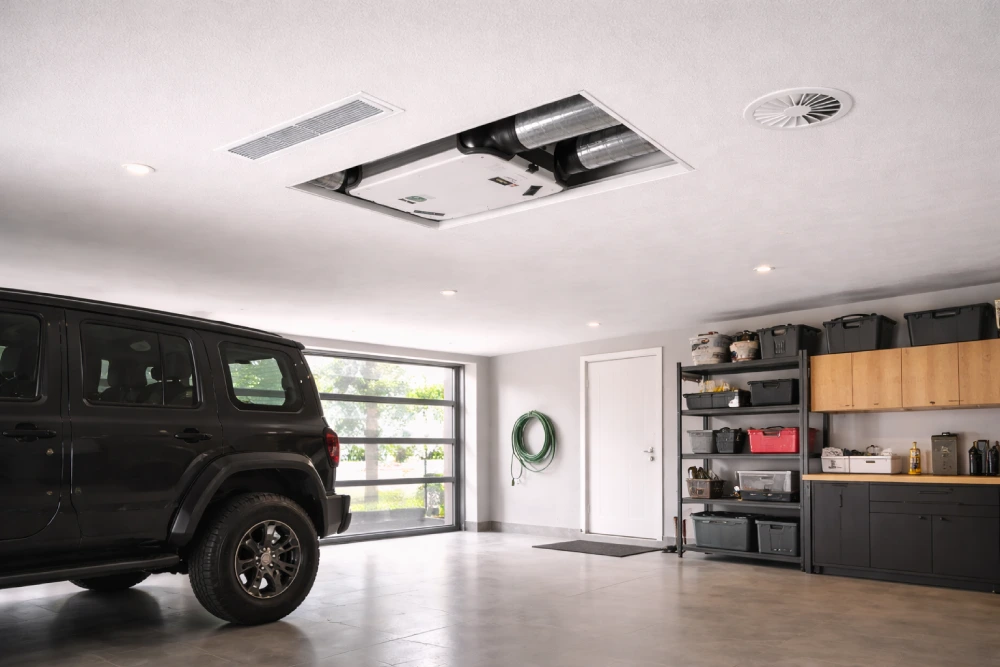
Dual-flow ventilation (VMC-DF) is an air renewal system that operates via two completely independent duct circuits—one for extract and one for supply—and a heat recovery unit that transfers between 75% and 95% of the thermal energy from the outgoing air to the incoming air, without mixing the two air streams.
Unlike single-flow ventilation, VMC-DF does not only extract stale air: it also supplies filtered, thermally pre-conditioned air, making it the most energy-efficient and most comfortable option among all mechanical ventilation solutions.
How dual-flow ventilation works
A dual-flow ventilation system consists of four main components that work in coordination:
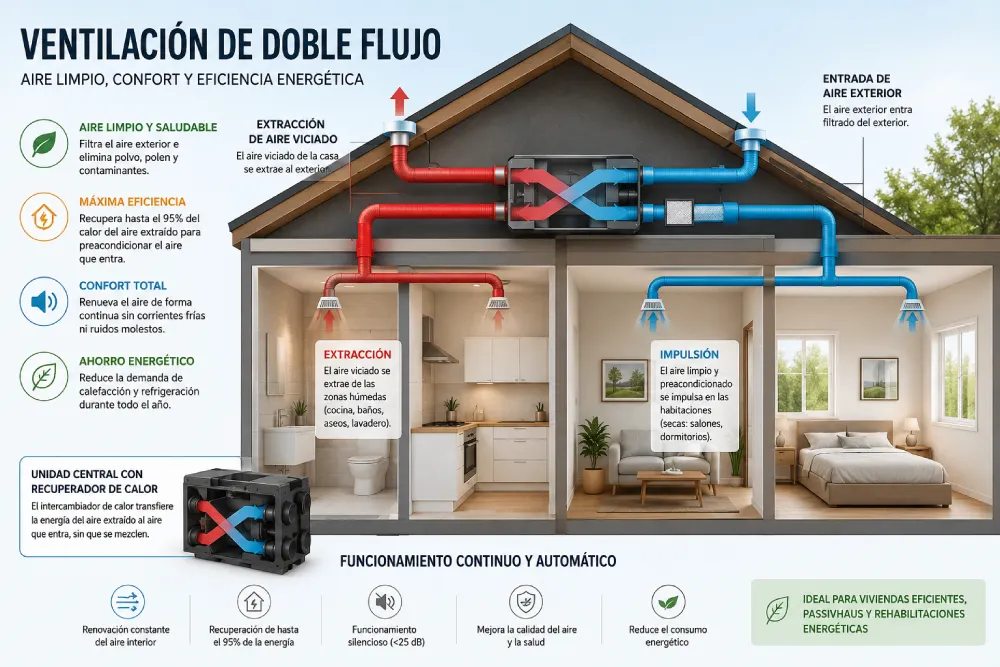
Extract network:
extract grilles in kitchens, bathrooms and WCs draw humid, stale air through galvanised sheet-metal or semi-rigid ducts to the central unit.
Heat recovery unit:
the extracted air and the outdoor air pass on opposite sides of the heat exchanger. Thermal energy is transferred from one stream to the other without the air streams mixing. In winter, the heat recovery unit warms the cold outdoor air using the heat from the expelled indoor air. In summer, with the summer bypass activated, the exchanger is bypassed to take advantage of cooler night air without recovering indoor heat.
Filters:
before entering the home, outdoor air passes through one or more filters that trap dust, pollen, particles and pollutants. The filter class determines what particle size it captures.
Supply network:
the filtered, pre-conditioned air is distributed to bedrooms and living rooms through low-velocity supply grilles to avoid uncomfortable draughts.
The heat recovery unit: types and real-world performance
The heat recovery unit is the element that sets dual-flow ventilation apart from any other system. There are two main technologies:
Sensible heat exchanger (heat only)
Transfers only thermal energy (temperature) between the two airflows. It does not recover humidity. It is the standard option in Mediterranean climates such as Barcelona, where high indoor humidity in winter does not require recovery. Typical efficiency: 75–88%.
Enthalpy exchanger (heat + humidity)
Transfers both heat and relative humidity. It prevents the home from becoming excessively dry during winter in cold, continental climates. Typical efficiency: 80–92%. Higher cost than a sensible exchanger: a difference of €300–€800 depending on the range.
Summer bypass
This is a damper integrated into the unit that, when the outdoor night-time temperature drops below the indoor temperature, diverts the incoming air directly without passing through the exchanger. In this way, the home is cooled for free overnight without using energy for air conditioning. It is a key feature in Catalonia’s Mediterranean climate.
Real-world performance depending on outdoor temperature
(sensible exchanger, 85% efficiency):
| Outdoor temp. | Indoor temp. | Supply air temp. | Without VMC-DF |
|---|---|---|---|
| 0°C | 20°C | ~17°C | 0°C (direct cold air) |
| 5°C | 20°C | ~18°C | 5°C (direct cold air) |
| 10°C | 21°C | ~19°C | 10°C (direct cold air) |
The home is ventilated without cold draughts and without the heating system having to compensate for the intake of outdoor air. This is the source of the distinctive thermal comfort provided by dual-flow ventilation.
Filter guide: classes, environments and maintenance
The filters in a dual-flow ventilation system are the component that most directly determines indoor air quality. The current classification is the EN ISO 16890 standard (which in 2018 replaced the old EN 779):
| EN ISO 16890 class | EN 779 equiv. | Particles captured | Recommended environment |
|---|---|---|---|
| Coarse 50% | G4 | >10 µm (coarse dust, pollen) | Clean rural / peri-urban |
| ePM10 50% | F7 | >1 µm (PM10 + PM2.5 fraction) | Standard urban |
| ePM1 50% | F9 | >0.3 µm (PM2.5 and PM1) | Dense urban, heavy traffic |
In homes in Barcelona’s Eixample or in areas with heavy traffic, the minimum recommended class is ePM10 50% (equivalent to the former F7) for the supply filter. For people with allergies or asthma, ePM1 50% (former F9) or HEPA filters are the most suitable option.
Replacement frequency:
every 6–12 months depending on the environment and use. In dense urban environments, every 6 months. The most reliable indicator is the pressure drop measured by the unit itself (many units have a dirty-filter alarm).
Filter maintenance cost:
between €15 and €40 per set of filters, depending on class and brand. The total annual maintenance cost of dual-flow ventilation—filters + technical inspection—ranges from €60 to €150/year.
Thermal comfort: what sets dual-flow apart from single-flow
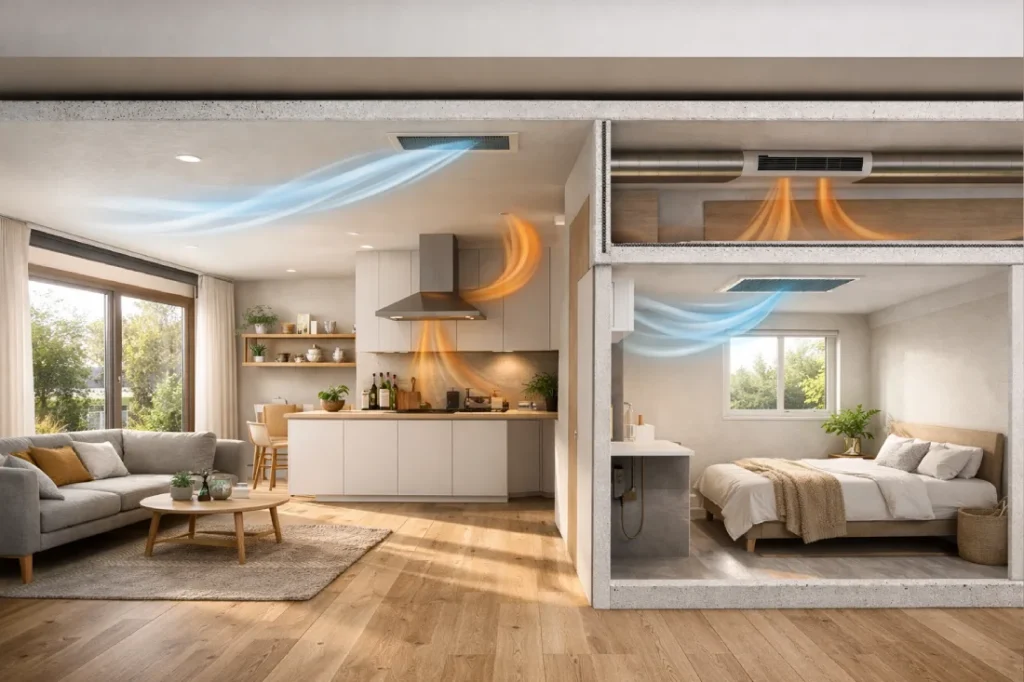
Single-flow ventilation brings in outdoor air without conditioning it. In winter, that means air inlets delivering 5–10°C air directly into rooms, creating cold draughts and forcing the heating system to compensate.
Dual-flow ventilation delivers the same air volume but already at 17–19°C (with 5°C outdoors and an 85% heat recovery unit). The result is constant air renewal without the sensation of cold draughts, without sudden temperature drops, and without extra heating costs. In summer, with the summer bypass activated during cool Mediterranean nights, the system cools the home for free.
Single-flow vs dual-flow MVHR: technical comparison
| Feature | Single-flow MVHR (SF) | Dual-flow MVHR (DF) |
|---|---|---|
| Supply circuit | No (passive intake via air inlets) | Yes (independent network) |
| Heat recovery | No | Yes (75–95%) |
| Outdoor air filtration | No | Yes (Coarse to ePM1 depending on the unit) |
| Winter thermal comfort | Low (cold draughts) | High (pre-conditioned air) |
| Electric consumption | 15–40 W | 30–80 W |
| Installation cost (80–100 m²) | €1,200–€2,500 | €3,500–€7,000 |
| Annual maintenance | €30–€80 | €60–€150 |
| Energy rating improvement | Marginal | Yes (up to 1–2 letters) |
| CTE HS3 compliance | Full | Full |
When to choose single-flow: refurbishments with a tight budget where the main goal is to comply with regulations and control humidity. When to choose dual-flow: airtight homes, Passivhaus-standard projects, projects seeking a better energy rating, or maximum thermal comfort without sacrificing efficiency.
How much does dual-flow ventilation save per year?
This is the most common question—and the one most sources answer the worst. Indicative figures for a typical home in Barcelona:
| Floor area | Estimated heating savings/year | VMC-DF electricity consumption/year | Net annual savings |
|---|---|---|---|
| 60 m² | €150–€300 | €40–€60 | €90–€240 |
| 100 m² | €250–€450 | €60–€90 | €160–€390 |
| 150 m² | €400–€700 | €80–€120 | €320–€580 |
Estimates for a coastal Mediterranean climate, a well-insulated home, and a gas heating system. Savings vary depending on habits, building airtightness and energy prices.
Indicative payback: with an investment of €4,500 (average VMC-DF installation for 100 m²) and net savings of €160–€390/year, the energy-only payback is between 12 and 28 years.
That is why the main argument for dual-flow ventilation is not pure energy savings, but the combination of air quality, thermal comfort, improved energy rating and regulatory compliance. The cost of not ventilating properly—moisture damage, mould, deterioration of finishes—can far exceed that investment within a few years.
In homes with an F or G energy rating undergoing a full refurbishment, installing dual-flow ventilation combined with envelope improvements can mean moving up one or two letters on the energy certificate, which directly impacts the property’s sale or rental value.
When it is worth installing dual-flow ventilation
Comprehensive energy refurbishments
A refurbishment that improves façade insulation and replaces windows without incorporating mechanical ventilation worsens indoor air quality by increasing airtightness. Dual-flow ventilation should be designed in parallel with any envelope improvement. In addition, the refurbishment phase is when it is easiest and most cost-effective to run the ducts, especially if there is access to a suspended ceiling or the flooring is being redone.
Airtight new-build homes
Current CTE requirements for energy efficiency have made new homes increasingly airtight. A home with an n50 below 3 h⁻¹ cannot be adequately ventilated naturally: dual-flow ventilation is the only solution that guarantees continuous renewal without losing the airtightness achieved.
Older flats in dense urban environments
In homes in Barcelona’s Eixample or in areas with high traffic-related pollution, dual-flow ventilation with ePM10 50% or ePM1 50% filters removes PM2.5 particles before introducing air into the home. It is also the most effective solution for granitic areas of Catalonia (Pyrenees, Garrotxa, Montseny), where radon from the subsoil can accumulate indoors.
Passivhaus standard
The Passivhaus standard requires an air permeability of n50 ≤ 0.6 h⁻¹, which makes virtually any form of controlled natural ventilation impossible. Dual-flow ventilation with heat recovery is the only system compatible with this level of airtightness and is mandatory for Passivhaus certification.
How much does it cost to install dual-flow ventilation?
The price of a dual-flow ventilation system depends on six factors:
| Factor | Impact |
|---|---|
| Home floor area | More m² means more ducts and terminals |
| Type of exchanger (sensible vs enthalpy) | Difference of €300–€800 |
| New build vs refurbishment | In refurbishments, duct routing is more costly |
| Whether there is an existing suspended ceiling | Without a suspended ceiling, the cost increases by 20–40% |
| Brand and range of the unit | From entry-level to premium: €500–€2,000 difference |
| Number of rooms ventilated | Each additional terminal: €80–€150 |
Indicative installed ranges for an 80–100 m² home:
- Entry-level range: €3,500–€4,500
- Mid-range (most commonly installed): €4,500–€6,000
- High-end / Passivhaus: €6,000–€8,000
Among the leading manufacturers in the Spanish market for VMC-DF are Zehnder, Siber, Daikin, S&P, Aldes and Airzone, with units across all price points. For a full breakdown of cost items, see our article on the price of forced ventilation.
Note on total life-cycle cost: adding the installation cost plus annual maintenance (€60–€150/year) over 20 years, the total cost of a standard-range VMC-DF is between €4,700 and €10,000 (€3,500 + €1,200 minimum; €7,000 + €3,000 maximum). The alternative—not ventilating properly—can cause moisture damage, mould and deterioration of finishes that in Barcelona homes typically cost €3,000–€8,000 to remedy in a damage refurbishment.
How much would it cost in your home? The exact price depends on the layout, existing ducts and the unit you choose. Request a no-obligation assessment → and you will receive a personalised quote with the real ranges for your case in Barcelona or Catalonia.
Grants and subsidies to install dual-flow ventilation in 2026
Installing dual-flow ventilation as part of a comprehensive energy refurbishment may be eligible for:
- PREE programme and Next Generation EU funds (IDAE): covers between 30% and 60% of the cost when VMC-DF is part of an accredited energy improvement measure. More information at idae.es/ayudas-y-financiacion/para-la-rehabilitacion-de-edificios.
- Grants from the Government of Catalonia (ICAEN): a programme specific to Catalonia, managed by the Institut Català d’Energia. More information at icaen.gencat.cat/es/energia/ajuts/edificis.
At Ecohabitats, we handle the technical project and the energy justification required to access these grants as part of our installation service in Barcelona, Barcelonès, Vallès and Maresme.
Installation process: 6 steps
- Technical visit and ventilation audit — analysis of the layout, airtightness and the needs of each space in accordance with CTE HS3.
- Dual-flow ventilation design — airflow calculations, duct routing, and selection of the unit and filter class.
- Duct installation — installation of the extract and supply networks, typically in a suspended ceiling or under the floor.
- Installation of the VMC-DF unit — positioning the unit, electrical connection, and connection to both duct networks.
- Installation of terminals and grilles — extract terminals in wet areas; low-velocity supply grilles in bedrooms and the living room.
- Balancing, commissioning and handover — airflow adjustment, verification of continuous noise levels, and handover of documentation (required for grants and technical inspection).
Conclusion on dual-flow ventilation
Dual-flow ventilation is the technically superior solution when the goal is to combine air quality, thermal comfort and energy efficiency in a single installation. Its higher cost compared to single-flow ventilation is justified in airtight homes, comprehensive refurbishments, and projects seeking to improve the energy rating or comply with the Passivhaus standard.
At Ecohabitats, we design and install dual-flow ventilation systems tailored to each home in Barcelona and Catalonia. Visit our page on forced ventilation systems or contact our technical team to receive a personalised assessment.
Article written by Pablo Santillana, an Ecohabitats architect specialising in sustainable architecture, energy refurbishment and comprehensive renovations in Barcelona and Catalonia.
Frequently asked questions about dual-flow ventilation
What is the difference between single-flow and dual-flow ventilation?
Single-flow ventilation extracts air from wet areas and allows passive intake of unconditioned, unfiltered outdoor air. Dual-flow ventilation adds a supply network with a heat recovery unit that pre-conditions the incoming air (preventing cold draughts) and filters that trap particles, pollen and pollutants. The difference in comfort is significant; the difference in installation cost is €2,000 to €4,500 for a 100 m² home.
How much does it cost to install dual-flow ventilation?
The price of an installed dual-flow ventilation system for an 80–100 m² home ranges from €3,500 (entry-level) to €7,000–€8,000 (high-end or Passivhaus). The factors that most influence the final price are floor area, exchanger type (sensible or enthalpy), whether a suspended ceiling is available, and the brand of the unit. Annual maintenance adds €60–€150/year.
How much does dual-flow ventilation save per year?
In a 100 m² home in Barcelona with gas heating, heating savings can be €250–€450/year. After subtracting the system’s electricity consumption (€60–€90/year), net savings are €160–€390/year. The energy-only payback is 12–28 years; the real investment case includes air quality, comfort and increased property value.
Are there any grants to install dual-flow ventilation in 2026?
Yes. The PREE programme (Next Generation EU funds, managed by IDAE) and grants from the Government of Catalonia (ICAEN) can cover between 30% and 60% of the cost when the installation of dual-flow ventilation is part of a comprehensive energy improvement measure for the building.
Does dual-flow ventilation eliminate humidity?
It controls condensation-related humidity through constant air renewal, reducing vapour before it becomes saturated. It is not a dehumidifier: it addresses the source of the problem (excess vapour in indoor air) rather than extracting moisture from already saturated air. For severe damp issues caused by water ingress or rising damp, VMC-DF must be combined with specific building solutions.
Does dual-flow ventilation use a lot of electricity?
No. A dual-flow ventilation system consumes between 30 and 80 W in continuous operation, equivalent to €40–€100/year in electricity. That is 5 to 15 times less than a conventional dehumidifier (200–500 W). In most cases, the heating energy saved thanks to the heat recovery unit exceeds the system’s electricity cost.
Can it be installed in an older flat without major building work?
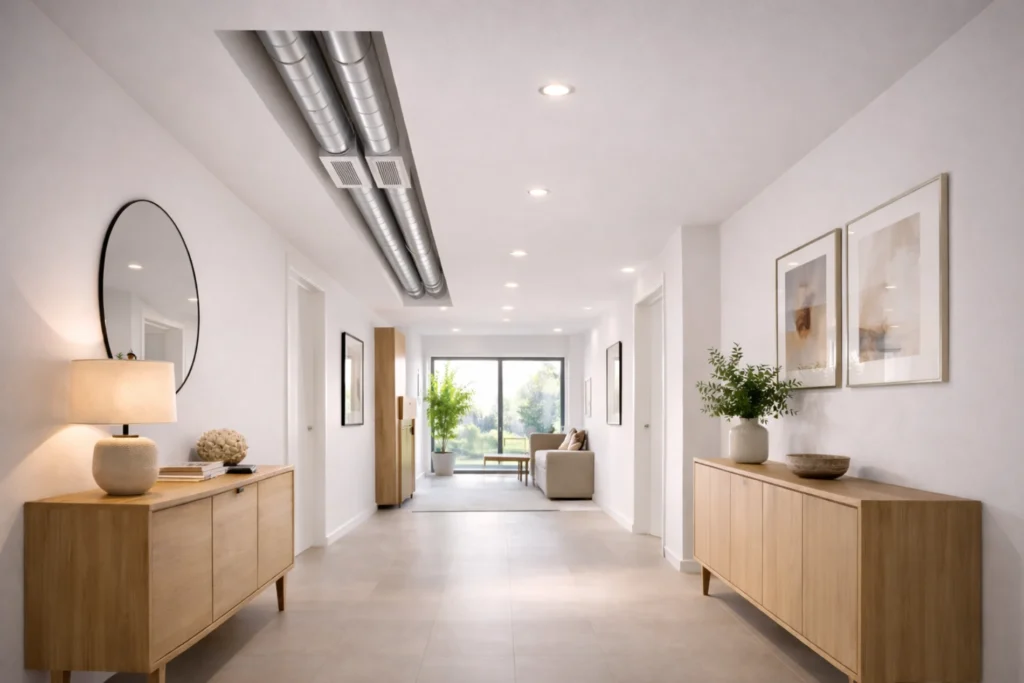
Yes, although it requires a prior technical design. Dual-flow ventilation can be integrated into existing flats using small-diameter flexible ducts (Ø63–125 mm) run through a suspended ceiling. Without a suspended ceiling, ducts can be left exposed with a white finish or integrated into joinery. The cost increases by 20–40% compared to a new-build installation with an available suspended ceiling.
Is dual-flow ventilation noisy?
Modern VMC-DF units operate continuously at low speed with sound levels below 25 dB(A) in rooms—equivalent to the murmur of a distant conversation. Dual-flow systems are often quieter than single-flow systems because the two fans operate in balance at a lower individual speed. Noticeable noise in an installation usually indicates incorrect duct sizing or excessive air velocities, not a defect in the unit.
Is dual-flow ventilation compatible with aerothermal heat pumps?
Yes, and in fact they complement each other. Aerothermal systems generate heat (or cooling) efficiently; dual-flow ventilation manages air quality and reduces thermal demand through heat recovery.
They are independent systems that operate in parallel: VMC-DF does not replace aerothermal heating, nor vice versa.
In homes with both systems, heating demand can be reduced by up to 40–60% compared to a conventional home with neither system.


