
Updated: May 2026 · Article written by Pablo Santillana, an architect specialising in the installation of ventilation systems in Barcelona and Catalonia.
Controlled mechanical ventilation (CMV) is a continuous air renewal system that uses electromechanical equipment—fans, ducts and air-handling units—to extract stale indoor air and introduce filtered outdoor air autonomously, according to the airflow rates calculated under CTE HS3 regulations. It operates 24 hours a day regardless of the weather, user habits or the building’s orientation.
This technical guide answers the questions that arise when assessing which type of CMV a home needs: how it works internally, what differentiates each option, how much it consumes, how much it costs to install and what grants are available in 2026. If what you are looking for is to understand why controlled mechanical ventilation is the definitive solution to indoor air quality and humidity problems in homes, we explain it in detail on our page about forced ventilation systems for homes.
How controlled mechanical ventilation works internally
Controlled mechanical ventilation operates on a differentiated air circuit with two independent air streams that never mix:
Extract: extract vents located in wet areas—kitchens, bathrooms, WCs—draw stale air through galvanised sheet-metal or semi-rigid ducts to the central unit or directly outdoors.
Supply: outdoor air enters filtered through G4 or F7 class filters (depending on the area’s pollution level) and, in double-flow CMV, receives recovered thermal energy before being distributed to bedrooms and the living room through an independent duct network.
The central unit of the controlled mechanical ventilation system may include: enthalpy or sensible heat recovery units, humidity-controlled modules, anti-pollution filters, a summer bypass (a damper that in summer bypasses the exchanger to take advantage of cooler night air) and CO₂ sensors for automatic airflow adjustment. The design airflow is calculated according to CTE HS3 based on the floor area and the number of occupants in each room.
Types of controlled mechanical ventilation: which one fits each case
Standard single-flow CMV (CMV-SF)
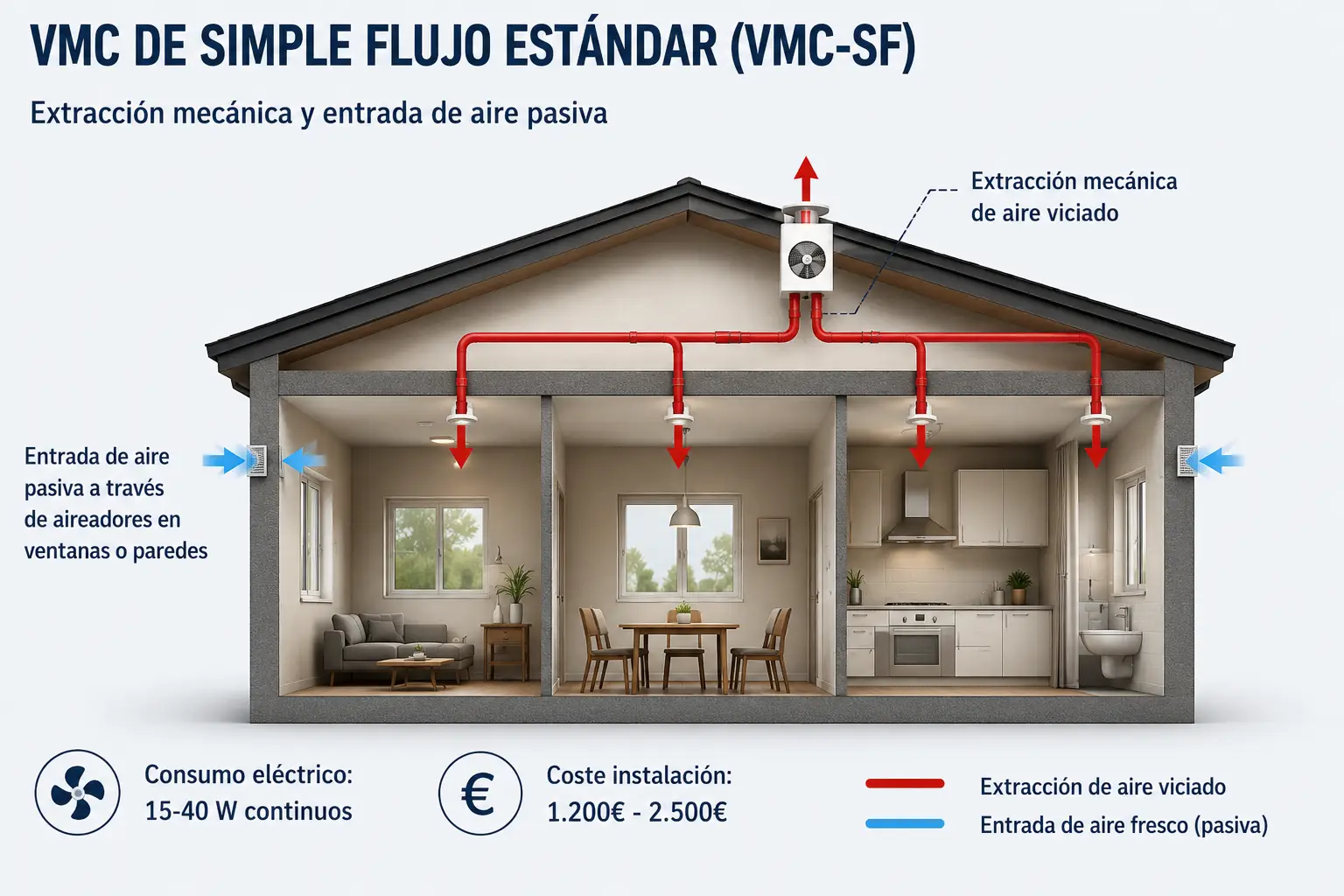
It extracts air from wet areas through fixed-flow extract vents connected to a central fan. Fresh outdoor air enters passively through fixed air inlets in windows or walls in dry rooms. It is the lowest-cost option and the most common in typical homes.
Electricity consumption: 15–40 W continuous → €25–€60/year in electricity.
Humidity-controlled single-flow CMV (CMV-SFH)
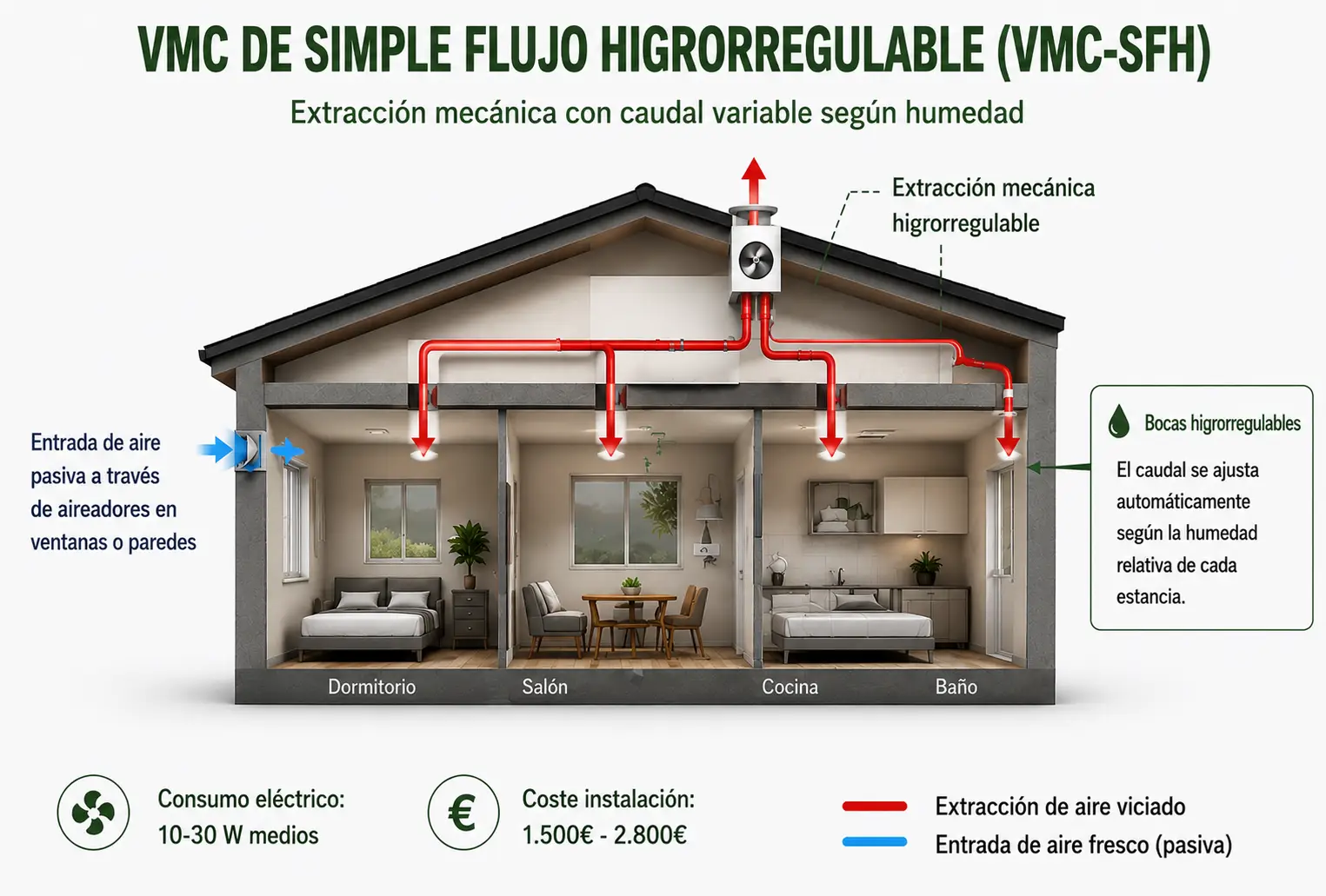
A smart variant of the above: the extract vents automatically adjust airflow according to the relative humidity in each room, reducing consumption when the space is not in use. It is the most common solution in refurbishments with tight budgets because it optimises performance without the need for a second duct network.
Electricity consumption: 10–30 W average → €15–€45/year in electricity.
Double-flow CMV with heat recovery (CMV-DF)
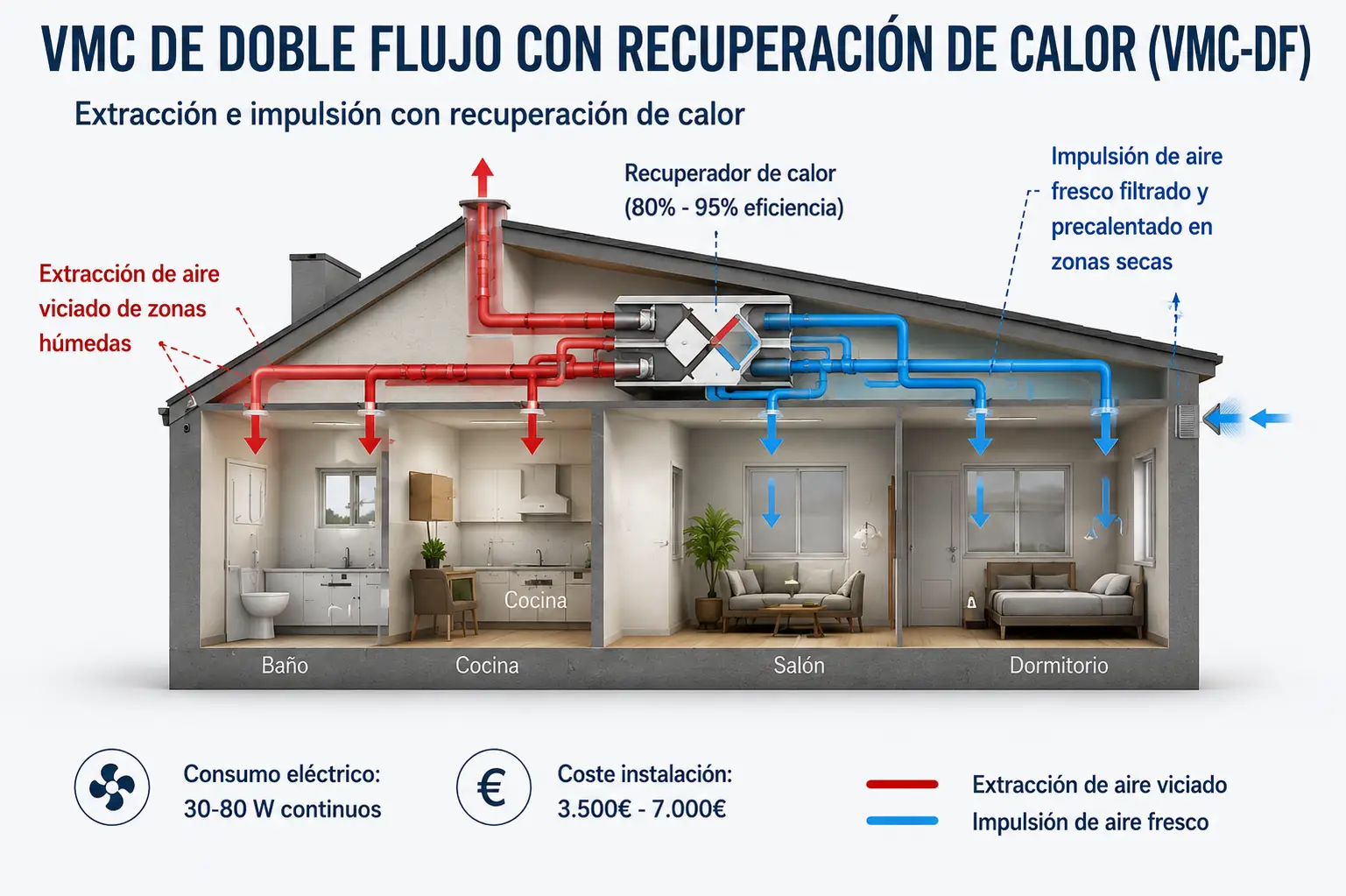
Double-flow controlled mechanical ventilation has two independent duct networks: extract and supply. Between both air streams, an enthalpy or sensible heat recovery unit transfers between 80% and 95% of the thermal energy from the outgoing air to the incoming air, without mixing them. The home is properly ventilated without significant heat loss in winter or cool loss in summer.
This type of controlled mechanical ventilation is recommended for Passivhaus certifications, A or B energy ratings, and refurbishments seeking to improve their energy rating. In projects in the Barcelona area, installing a CMV-DF has made it possible to move from a D rating to C—or even B—by reducing the building’s heating demand.
Electricity consumption: 30–80 W depending on design airflow → €40–€100/year in electricity.
Technical comparison: CMV vs other systems
Table 1 — Technical characteristics
| System | Airflow control | Energy efficiency | Electricity consumption | CTE HS3 |
|---|---|---|---|---|
| Natural Ventilation | No | Low | 0 W | Partial |
| Spot extractor fan | Partial | Low | 10–25 W | Partial |
| Single-flow CMV | Yes | Medium | 15–40 W | Full |
| Double-flow CMV | Yes | Very high | 30–80 W | Full |
Table 2 — Indicative cost for an 80–100 m² home
| System | Installation | Annual maintenance |
|---|---|---|
| Spot extractor fan | €150–€500 | Minimal |
| Single-flow CMV | €1,200–€2,500 | €30–€80 |
| Double-flow CMV | €3,500–€7,000 | €60–€150 |
The fundamental difference between controlled mechanical ventilation and spot extractor fans is continuity: a bathroom fan runs when someone switches it on; CMV runs all the time, with the exact airflow rates required by regulations at each point in the building. You can expand this comparison in our article on forced ventilation vs natural ventilation.
CMV vs dehumidifier: they are not equivalent
A dehumidifier removes moisture from the air but does not renew it, does not remove CO₂ or volatile organic compounds, and consumes between 200 and 500 W continuously—between 5 and 15 times more than a CMV system. Controlled mechanical ventilation addresses the cause: it replaces indoor air with filtered outdoor air. A dehumidifier is a stopgap measure; CMV is the underlying technical solution.
Indoor air quality: reference values
According to the World Health Organization’s guidelines for indoor air quality (WHO Guidelines for Indoor Air Quality, 2009), people in urban environments spend between 80% and 90% of their time indoors people in urban environments spend between 80% and 90% of their time indoors.
A properly sized controlled mechanical ventilation system keeps CO₂ below 1,000 ppm—a threshold above which, according to Allen et al. (Harvard, Environmental Health Perspectives, 2016), cognitive performance drops by 15% to 50%. In bedrooms without CMV, it is common to exceed 1,500–2,000 ppm overnight.
In addition to CO₂, controlled mechanical ventilation reduces:
- Volatile organic compounds (VOCs) emitted by paints, adhesives and furniture.
- Airborne allergens, spores and dust mites.
- PM2.5 particles when F7-class filters or higher are installed.
- Radon, particularly relevant in granite areas of Catalonia and Galicia.
CTE HS3 regulations: minimum required airflow rates
The CTE HS3 Basic Document on Indoor Air Quality (Ministry of Transport, Mobility and Urban Agenda) establishes the minimum ventilation airflow rates that must be ensured in all new-build homes and in major refurbishments. Compliance is mandatory; non-compliance may lead to rejection at technical inspection and create liabilities for the developer or the site manager.
| Room | Minimum required airflow |
|---|---|
| Bedrooms | 4 l/s per person |
| Living rooms and lounges | 4–8 l/s per room |
| Kitchens | 7.5–15 l/s depending on cooking type |
| Bathrooms | 4–8 l/s per room |
| WCs | 4 l/s per room |
How much does it cost to install controlled mechanical ventilation?
The final price of a controlled mechanical ventilation system depends on six main factors:
| Factor | Impact on price |
|---|---|
| Type of CMV (SF / SFH / DF) | Main factor: CMV-DF costs 2–3 times more than CMV-SF |
| Home floor area | The larger the area, the more ducts and vents |
| New build vs refurbishment | In refurbishments, routing ducts is more costly |
| Access: existing suspended ceiling or not | Without a suspended ceiling, costs increase by 20–40% |
| Brand and range of the heat recovery unit | A €500–€1,500 difference between entry-level and premium ranges |
| Number of rooms served | Each additional vent adds €80–€150 |
Leading manufacturers in the Spanish market include Zehnder, Siber, Daikin, S&P and Airzone, with equipment for all price ranges and floor areas.
For a detailed breakdown of cost items, see our article on the cost of forced ventilation.
A note on energy ROI: the purely energy-based payback of a CMV-DF (estimated savings of €150–€400/year in heating versus an investment of €4,000–€6,000) is 10 to 30 years. The core argument for controlled mechanical ventilation is air quality, health and regulatory compliance—not pure energy savings. Being transparent about this is part of rigorous technical advice.
Grants and subsidies to install a CMV system in 2026
Installing a controlled mechanical ventilation system may be eligible for support under the Recovery, Transformation and Resilience Plan (Next Generation EU funds), through the PREE (Programme for the Energy Rehabilitation of Buildings) and the Generalitat de Catalunya’s regional programmes, when it forms part of a comprehensive intervention to improve the building’s energy efficiency.
Grants can cover between 30% and 60% of the eligible cost, depending on the building type, the owners’ income and the scale of the proven energy savings.
At Ecohabitats, we handle the technical project, the energy justification and the grant documentation as part of the installation service. If your home is in Barcelona, Barcelonès, Vallès or Maresme, contact our team to review your case with no obligation.
CMV and the energy performance certificate
Double-flow controlled mechanical ventilation directly impacts the building’s energy rating: by recovering 80–95% of the energy from extracted air, it reduces heating demand—a key variable in the certificate calculation. In refurbishment projects carried out in the Barcelona metropolitan area, installing a CMV-DF has made it possible to move from a D rating to C or B when combined with envelope improvements.
This rating improvement has practical effects: it makes selling or renting the property easier, can improve the appraised value, and is a requirement for some public funding schemes.
CMV installation process: 7 steps
- Technical visit and data collection — the technician analyses the layout, airtightness and needs of each space.
- Ventilation design — calculation of the design airflow according to CTE HS3, duct routing and selection of the CMV unit.
- Duct installation — installation of the distribution network in the suspended ceiling or under the upper-floor slab.
- Installation of the central unit — positioning the unit, electrical connection and connection to the supply and extract networks.
- Installation of vents and grilles — extract vents in wet areas, supply grilles in dry areas.
- Balancing and commissioning — airflow adjustment at each vent, pressure verification and continuous noise level measurement.
- Handover of documentation — user manual, commissioning record and installation certificate, required to apply for grants and for technical inspection.
Frequently asked questions about controlled mechanical ventilation
Is controlled mechanical ventilation mandatory in new builds?
CTE HS3 requires all new-build homes to guarantee minimum ventilation airflow rates. Ventilation can be natural, mechanical or hybrid, but controlled mechanical ventilation is the most widely used solution because it guarantees those airflow rates regardless of outdoor conditions and user behaviour.
Can CMV be installed in an older home without major works?
Yes. Controlled mechanical ventilation can be integrated into refurbishments using small-diameter flexible ducts (Ø63–125 mm) routed through the existing suspended ceiling or under the floor. It does not necessarily require major works, although it does require a specific technical design.
How much electricity does a CMV system use?
A CMV-SF consumes 15 to 40 W continuously (€25–€60/year). A CMV-SFH consumes 10 to 30 W on average (€15–€45/year). A CMV-DF consumes 30 to 80 W (€40–€100/year). The consumption of controlled mechanical ventilation is 5 to 15 times lower than that of a conventional dehumidifier.
Are there grants to install a CMV system in 2026?
Yes. The PREE programme (Next Generation EU funds) and the Generalitat de Catalunya’s regional programmes can cover between 30% and 60% of the cost when the installation of controlled mechanical ventilation is part of an energy improvement intervention in the building.
What maintenance does controlled mechanical ventilation require?
Filter replacement or cleaning every 6–12 months (€20–€60) and an annual check of the central unit. Total cost: €30–€150/year depending on the type of unit. Double-flow controlled mechanical ventilation also requires checking the condition of the heat exchanger annually.
CMV or a dehumidifier for humidity?
They are not equivalent. Controlled mechanical ventilation renews the air, removing CO₂, VOCs and moisture with 15–80 W of consumption. A dehumidifier only removes moisture from already stale air with 200–500 W. For condensation humidity, CMV addresses the root cause; a dehumidifier is a stopgap. We expand on this comparison in our article on humidity problems and poor ventilation.
Does CMV-DF improve the building’s energy rating?
Yes. By recovering 80–95% of the energy from extracted air, double-flow controlled mechanical ventilation reduces heating demand, a direct variable in the energy rating calculation. Combined with envelope improvements, it can mean moving from a D rating to C or B.
Does controlled mechanical ventilation generate noise?
Modern controlled mechanical ventilation units operate continuously at low speed with sound levels below 25 dB(A) in rooms—equivalent to a whisper. Excessive noise indicates incorrect duct sizing or air velocities that are too high, not an issue with the unit itself.
Article written by the technical team at Ecohabitats, architects specialising in the installation of controlled mechanical ventilation systems in Barcelona and the metropolitan area.

